Questionnaire participants
Across four desk-work groups.
Human–Robot Interaction, User Research, Workflow Design, Physical Computing, Prototyping
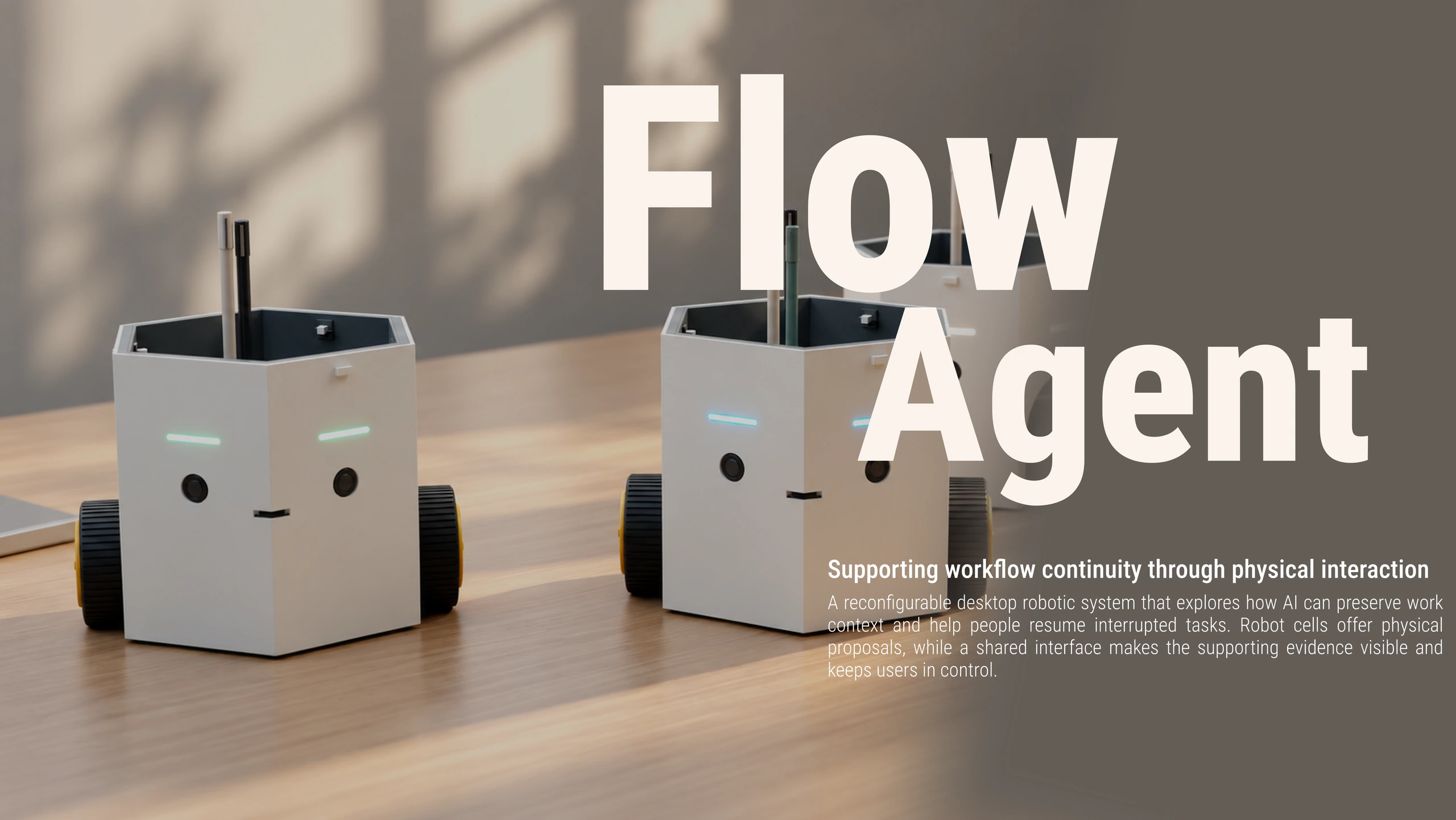
01 / The question
Human–robot interaction
After an interruption, finding a file is often easier than recovering the reasoning behind it. Flow Agent explores how a desktop robot system could preserve context and offer a physical path back into work.
The robot makes assistance noticeable. A shared interface makes the supporting evidence inspectable, so the person can correct, accept, or decline the proposal.
A proposal you can notice.
A reason you can inspect.
A choice you can decline.
02 / Formative research
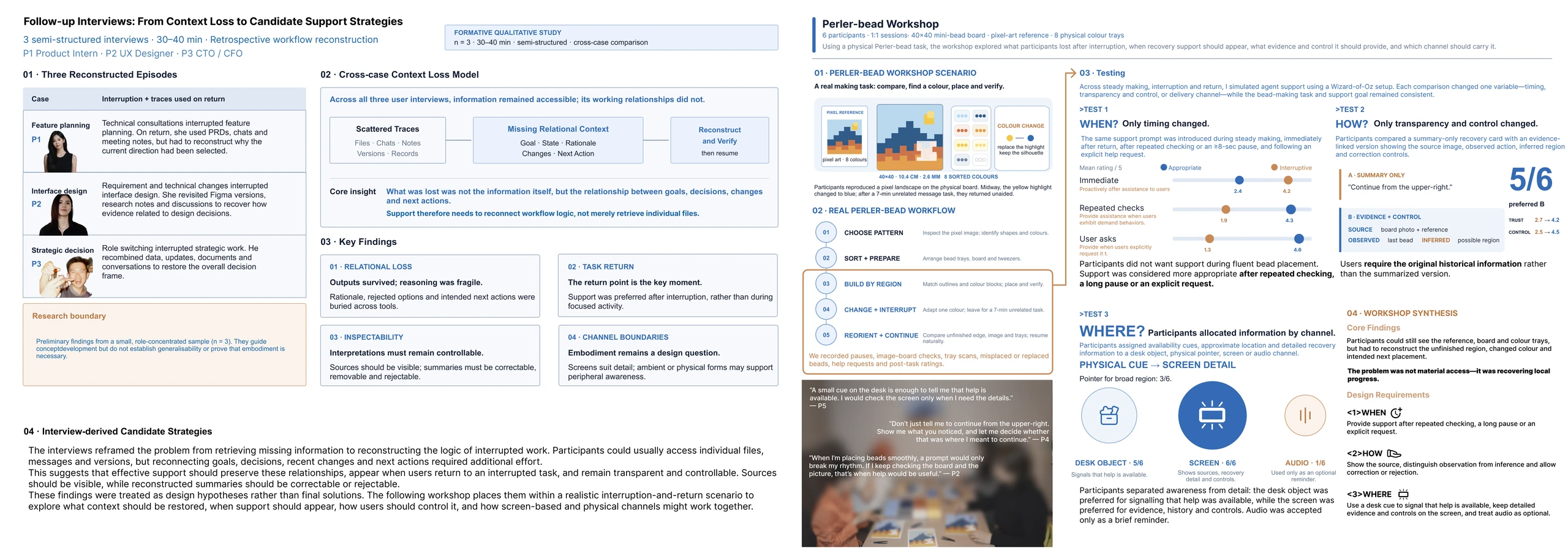
I combined a questionnaire, semi-structured interviews, and individual Wizard-of-Oz workshops. The research traced the gap between recovering an artefact and recovering the connections between a goal, a decision, and the next action.
Across four desk-work groups.
Reconstructing recent workflows.
Exploring when assistance feels appropriate.
A closer look
Repeated checking, a long pause, or a request became cues for considering an offer.
Five participants preferred evidence-linked support. A person should be able to correct or decline it.
All six allocated detailed information to a screen; five placed availability cues on a desk object.
03 / From evidence to behaviour
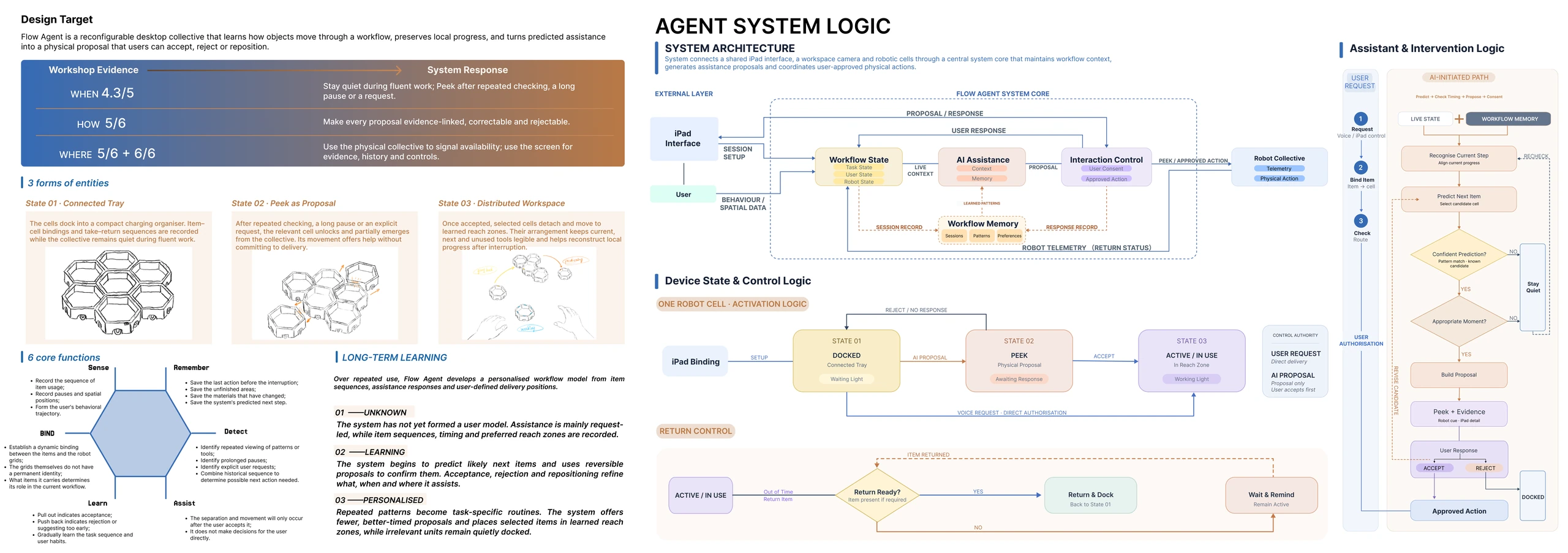
In the interaction concept, a small physical vocabulary makes the agent’s availability and intention visible. It separates an offer of help from an approved action, so a physical cue does not automatically commit the person to a suggestion.
The cells remain together as a charging organiser while focused work continues.
A relevant cell partially emerges after uncertainty or a request, without committing to delivery.
An accepted proposal allows a cell to detach and move towards a chosen reach zone.
A closer look
04 / The shared interface
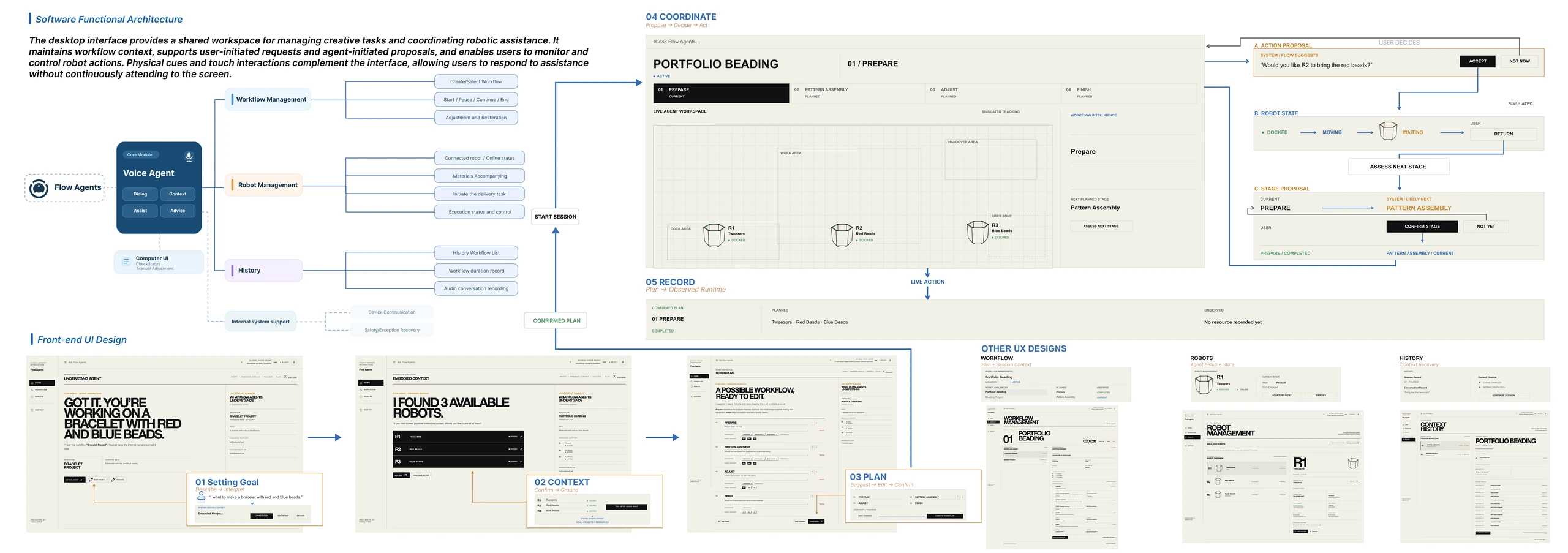
The interface links a proposed action to recent task context. In the portfolio-reading scenario, a shared workspace records the goal, assembles relevant evidence, and provides a path back into the interrupted activity.
Contextual memory and user control make assistance legible. Collective coordination and long-term personalisation remain proposed capabilities of the system.
A closer look
05 / Physical prototyping
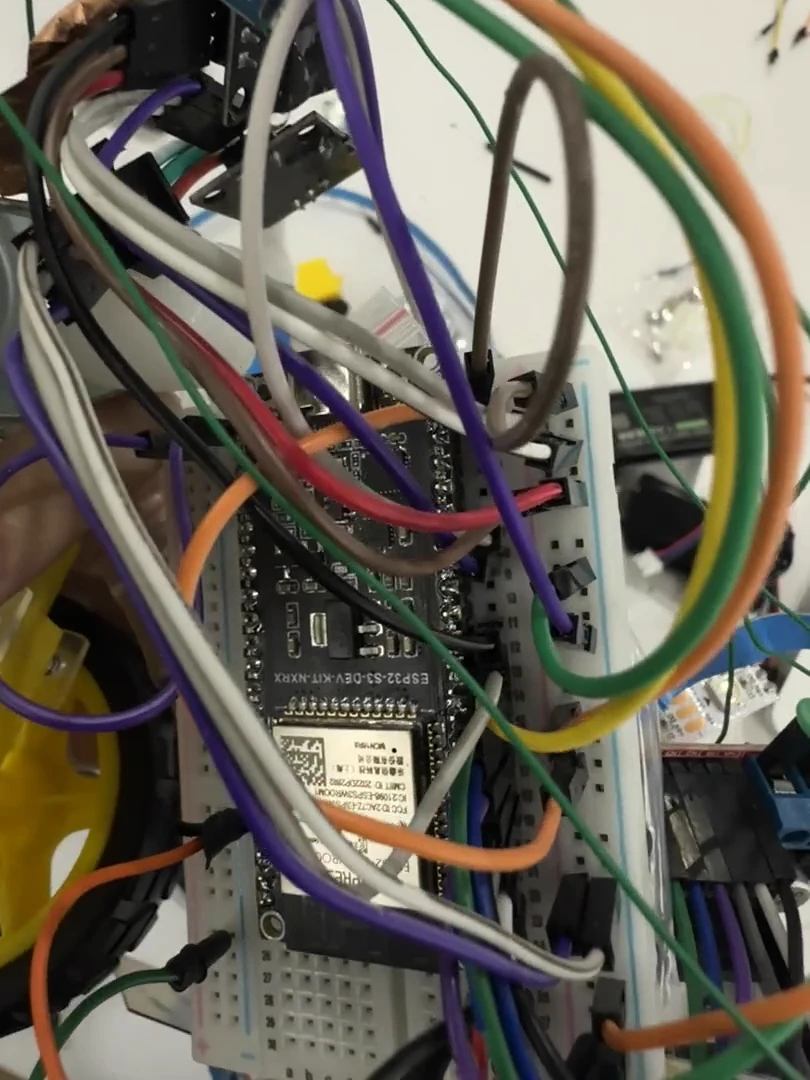
I built the hardware incrementally to explore motor control, sensing, status feedback, and docking before integrating an enclosure.
The platform includes an ESP32-S3 controller, geared motors, an L298N driver, load/pressure and touch sensing, WS2812B LEDs, and an infrared docking interface.
A closer look
Reflection
Helpful assistance begins with the right to say no.
The current work demonstrates formative research and hardware integration. Realistic desk-work evaluation and autonomous workflow understanding are the next development steps.For a complete reading
Every board, in full.
Open a board to explore the details.